


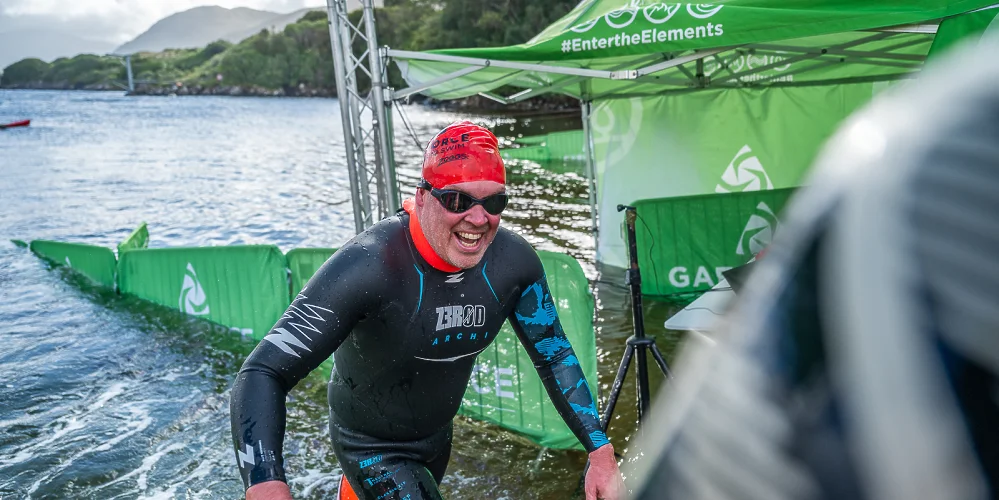
If you’ve signed up, or you’re thinking about signing up, for Gaelforce Great Swim Trilogy, you already know one thing: Irish water is rarely warm.
Cold water isn’t just part of the challenge, it’s part of the experience. But what actually happens inside your body the moment you take that first plunge?
Understanding how your heart and circulation respond to cold water can help you train smarter, stay safer, and perform better on race day.
The first 60 seconds: the cold shock response
The instant your body hits cold water, your nervous system fires into action. This is called the cold shock response.
Your breathing rate spikes. Your heart rate jumps. Blood vessels near the skin rapidly constrict. This shunts blood away from your extremities toward your core to protect vital organs.
For swimmers unaccustomed to cold exposure, this can feel overwhelming: gasping, chest tightness, and a pounding pulse. But here’s the key, this response is temporary. With regular, gradual exposure, your body adapts. The heart rate spike becomes less dramatic. Breathing becomes more controlled.
Learning to manage that first minute is often the difference between panic and performance.
Circulation shifts: protecting the core
As your blood vessels constrict, your body prioritises keeping your brain, heart, and lungs warm. Less blood flows to your hands and feet, which explains why fingers can feel stiff early in a swim.
Your heart works harder initially to pump against narrower vessels, slightly increasing blood pressure. Over time, however, regular cold-water swimmers often develop improved vascular tone: blood vessels become more responsive and efficient.
This is one reason many open-water swimmers report feeling more resilient over time. The cardiovascular system becomes better at adapting to environmental stress.
The adaptation effect: training your heart
With consistent exposure (done safely and progressively), your body becomes more efficient at handling cold.
Research shows habitual cold-water swimmers experience:
- Lower resting heart rate
- Reduced cold shock response
- Improved circulation control
- Greater parasympathetic (calming) nervous system activation after immersion
In simple terms: your heart learns not to overreact.
For athletes preparing for Gaelforce Great Swim Trilogy, this adaptation can improve confidence and composure on race day, especially during that crucial mass start when adrenaline is already high.
After the swim: the rewarming phase
When you exit the water, circulation shifts again. Blood vessels reopen, and warm blood flows back to your limbs. This is when you might feel tingling in your hands and feet.
Your heart rate gradually settles, and many swimmers experience a powerful sense of calm and wellbeing. Endorphins and adrenaline drop, leaving a natural high that’s part of why cold-water swimming becomes addictive.
However, this is also when proper recovery matters. Dry layers, warm fluids, and controlled rewarming help your cardiovascular system transition smoothly.
What this means for athletes
Cold water isn’t your enemy, it’s a training stimulus.
The key is gradual exposure. Start with short dips. Focus on controlled breathing. Never swim alone. Allow your cardiovascular system time to adapt before race distance sessions.
By the time you stand on the shoreline for your Gaelforce Great Swim event , your heart will know what to expect. Instead of shock, you’ll feel readiness. Instead of panic, control.
And when you dive in, it won’t just be about enduring the cold, it’ll be about thriving in it.
Back
